

Agnes, Shamim and Williams’ Story
From Whispers to Acceptance
“I gave birth to Agnes on 7th April 2021.
We didn’t know she had a condition, but she could get sudden jerks and then cry, so I asked myself, ‘Why is it that my child gets tremors and then cries?'” recalls Agnes’s mother, Shamim. “My husband asked me if I used to leave her in the cold, but I told him that I don’t leave her in the cold. He went on asking people about it, and they told him that we should visit the health facility for clarity.
“We first began noticing her tremors and frequent crying when she was about a month old, but we didn’t really understand what was happening. We assumed she might have cerebral malaria, known as ‘Yaabwe’ in Luganda. We didn’t think it was something serious, so we didn’t take her to the hospital or seek any treatment at that time. We simply continued caring for her as usual.
“When she turned three months old, we expected that she would at least be able to sit in a basin, as most children do at that age. However, every time we tried, she would fall, even when we cushioned the basin with clothes. I mentioned this to her father, saying that our child couldn’t sit properly, but he dismissed it, saying, ‘She’s still young and fat, so she is not ready for that yet. Stop trying to make her sit. Maybe she’s just weak.’ So, we stopped trying, and by the time she was five months old, we observed her again, but she still couldn’t sit in the basin or on the floor.
“We began to worry, wondering why. When we asked people in the village for advice, they started saying things like, ‘That child has a problem,’ or ‘That child will end up like this or that.’ Some even used the word ‘Omugogo.'” [a local term in Buganda used to describe children with cerebral palsy who appear stiff, immobile, or lifeless, like a log or banana stem].
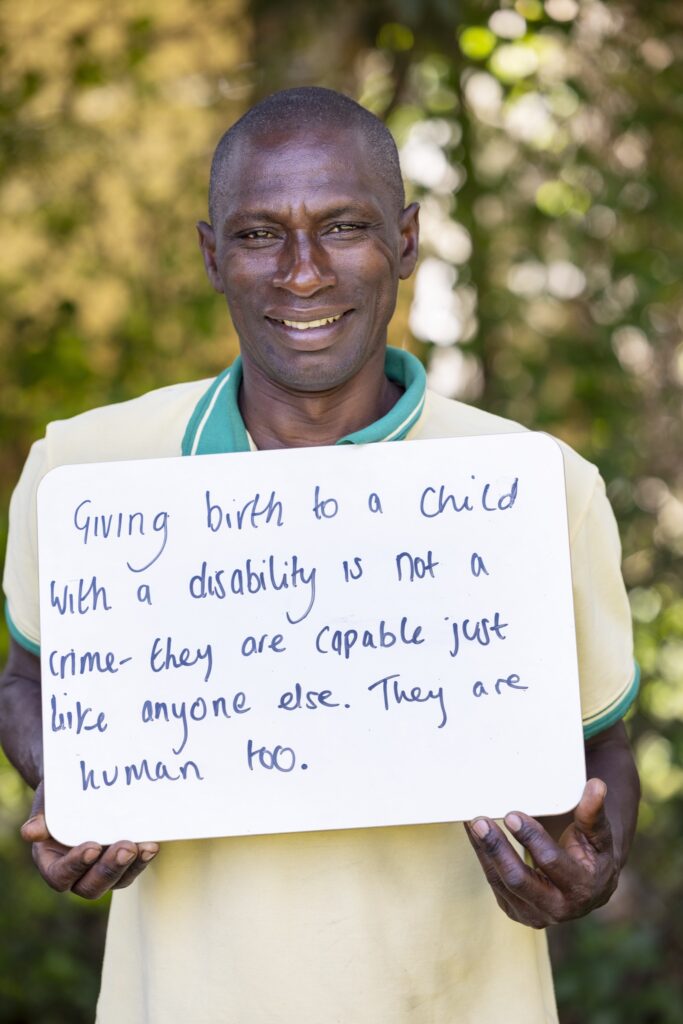
William, Agnes’ father, sharing his message about disability with the world
William, Agnes’ father, confirms it was a frightening time for the family: “We were scared when we first saw her situation. What scared me the most was the fact that she is my sixth-born and I had never given birth to a child with that condition. People could tell us, ‘That child is Omugogo’ and would give us different advice. Some of them told us to go to traditional healers, and others to go to the hospital.”
Searching for answers
Shamin continued, “So my husband suggested then that we take her to the hospital. When we arrived at the hospital, I stayed outside the hospital to keep watch over our boda boda (motorcycle taxi), so I didn’t go in myself, so my husband was the one who met with the doctor. The doctor told him, ‘Tell your wife that the child is healthy, but she needs to do physical exercises, and she should be brought regularly for physiotherapy sessions. The child’s brain development may be slower, and although her body is large and her head small, which means the brain might not fully support her growth, she will improve with proper care and exercise.’ When my husband came back and explained this to me, I didn’t really understand what the doctor meant by ‘physiotherapy,’ so I stayed at home without doing anything about it.
What helped us was that the doctor encouraged us not to use traditional healers but to start treatment for her seizures and to visit the hospital regularly to get medication for her. However, getting medicine there was very difficult; sometimes I would go and only receive one packet, and the doctor would tell me to buy the rest. Because we were struggling financially, there were times when she missed doses while we waited to raise money to buy more medicine.
“Once we began that treatment, her tremors and constant crying reduced. I told my husband about the improvement, but she would still sometimes curl herself up, bringing her head and legs together, rolling into a ball-like position, and cry. I kept wondering why she was doing that. When we returned to the hospital, the doctor explained that she was having convulsions, something we hadn’t understood before. They told us that each time she folded herself like that, it was convulsions. She still does it occasionally on one side, but she is improving, especially with regular massages.”
A careful balancing act
William also reflects on the challenges the family has faced caring for Agnes. “We are farmers, so you can’t say that you are going to go to the garden and dig for five hours and leave your child at home, so our farming activities are delayed because we have to take care of our child. Secondly, our financial situation is unstable. For example, we are always in and out of the hospital. We have just been recently discharged from the hospital, but we don’t stay long without having to go back because when she gets sick, she becomes so weak. They advised us that she needs to be cared for by specialists from a big hospital who can check her condition thoroughly and also give her better medicine that matches her body. With such a challenge, we need to be supported.”
Shamim continues: “Agnes doesn’t eat cassava, sweet potatoes, or porridge; she only eats Irish potatoes and drinks milk. I lose my peace when she doesn’t have milk to drink. When she spends the whole day without eating, I also lose my appetite; I can’t bring myself to eat cassava or sweet potatoes while she’s hungry. I would rather go without food than eat when she hasn’t.”
William also says that getting appropriate equipment can be a real challenge: “They gave us some supportive/adaptive chairs, but most of the children like mine weren’t measured, so she doesn’t fit in the one they gave her, and when you put her adaptive chair on, you can hardly tighten the belts because it’s not her size; it’s for a bigger child. She wasn’t in a position to get the one that she can fit in, so if she gets that supportive chair or a wheelchair, it’s easier for her to rest in it, and it can be helpful for us.”

Shamim, Agnes’ mother feeding her
Finding change is possible
“We got connected to Baby Ubuntu when Agnes was about one year and three months old,” Shamim says. “That’s when they began training us, and I finally learned how to do the physical exercises that I hadn’t known about before. Previously, I was only giving her medicine. After joining Baby Ubuntu, I started doing regular massages with her and taking her for physiotherapy sessions at the hospital. That’s when I began noticing change.
When asked what they would say to other parents who are just starting this journey, Shamim said:
“I would encourage [them] to stay strong, because that’s how we started. We never expected that our child would change, but each time you understand what has been taught to you and put it into practice, there is hope that your child will get better… I never thought that my child would sit. She is now four years old, and she can sit on her own.”
Shamim continued, “before joining Baby Ubuntu, Agnes had trouble eating, and I didn’t know how to prepare her food properly. Through that training, I learned how to feed her better, for example, how to mash Irish potatoes and prepare soft foods. Now she eats well, especially matooke (bananas) and Irish potatoes, and because of the knowledge and support, she has developed much better than she would have without their guidance.”
William adds, “Baby Ubuntu has benefited us in several ways. I am thankful that it has extended trainings for us. They also give us psychosocial support, tell us not to lose hope, bring us different people with disabilities, and we can see their different abilities in the activities they do, so this has made us hopeful, and we now believe that our child will be like them.”
“When I reflect on my daughter,” he adds, “she has raised my status to a place that I have never been. It’s because of her that I have been called to attend trainings, and I have been able to reach heights that I didn’t expect to go to.”
When asked what they would say to other parents who are just starting this journey, William said:
“… understand that this child was God-given… consider that child as their own… you can benefit more from that child as compared to a child without a disability. That child can be like any other person if taken care of, they shouldn’t be hidden in houses.”

Shamim, Agnes’ mother, sharing her message about disability with the world