
By Samual Semakula, Expert Father and Regional Lead, Uganda
There is something about travelling for work that you only fully understand when you return home. You leave carrying your organisation’s experience and the responsibility of representing the people and families behind the work. You return with new questions, new relationships, new ideas and, sometimes, a completely different way of looking at the work you thought you already knew well.
That was my experience travelling from Uganda to Lilongwe, Malawi, in July 2026 to represent Baby Ubuntu at the African Disability Collaboration (ADC) Summit.
I went to share. I went to train. I went to learn.
But somewhere between the training room, the exhibition stalls, the community outreach, the conversations with colleagues from across Africa and, of course, a few plates of Nsima, I realised that this was becoming much more than a conference trip.
Carrying Baby Ubuntu to Malawi
Baby Ubuntu is built around a simple but powerful idea: children with developmental disabilities and their families should receive support early, and caregivers should be empowered to become active partners in their child’s development.
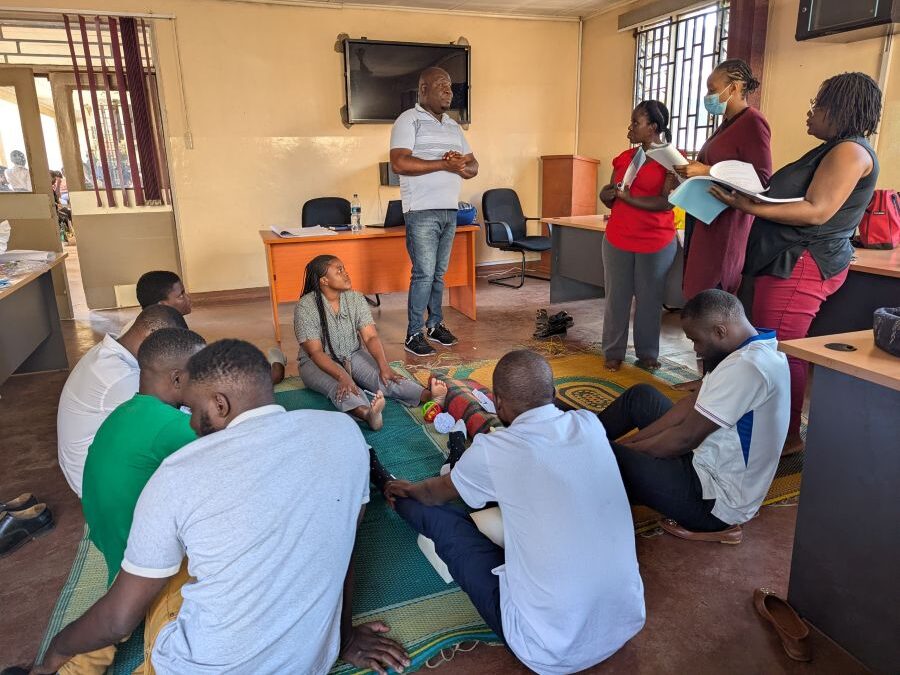
One of the first opportunities to put this into practice was the training of 12 multidisciplinary professionals from six health facilities across Lilongwe Districtas Baby Ubuntu facilitators. These teams are now taking the programme into their own health facilities alongside services for older children with disabilities. For me, this was one of the most significant outcomes of the trip. Training a facilitator is not simply about transferring knowledge, it is about creating another person who can sit with a caregiver and say: “I understand what you are going through. Let us see what we can do together.”
From the training room to the exhibition floor
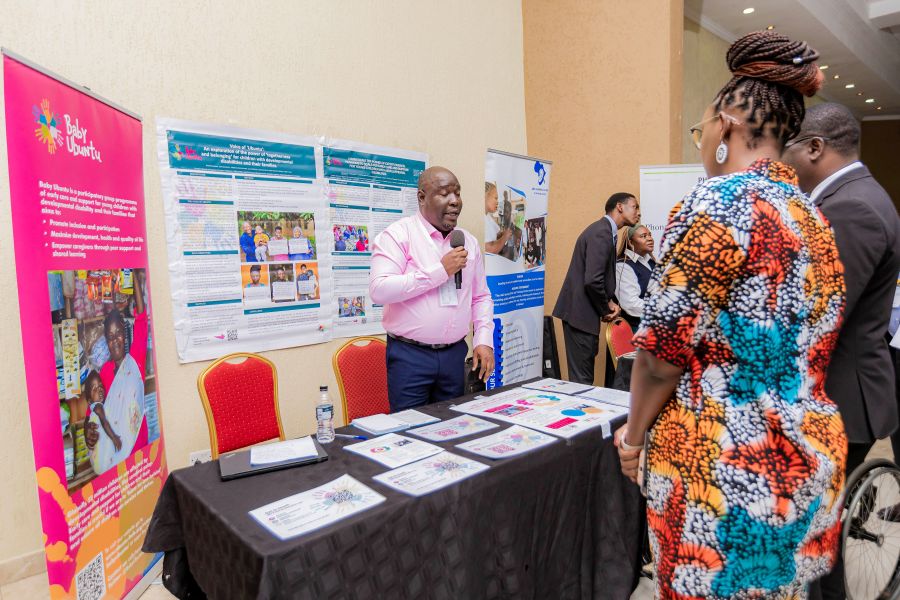
Sam talking at the Baby Ubuntu display at the ADC Summit exhibition, sharing Uganda’s experience of family-centred early intervention with delegates from across Africa.
One of the most exciting parts of the ADC Summit was seeing the work of organisations from across Africa brought together in one exhibition space, and Baby Ubuntu was not there simply as a visitor. We exhibited the Baby Ubuntu programme, sharing our approach to early intervention, caregiver engagement and family-centred support. The conversations that followed with people who were curious about how the model works in practice demonstrated that Baby Ubuntu has something valuable to contribute to the wider African disability and rehabilitation movement.
But the exhibition also reminded me that we are not the only ones innovating. Around us were organisations demonstrating locally developed solutions, assistive technologies, community-based approaches and new ways of strengthening disability services. It was a reminder that innovation does not always have to be expensive, imported or technologically complicated. Sometimes innovation is simply finding a solution that works because it understands the local context.
And that is a lesson Baby Ubuntu can continue to embrace.
Designing with caregivers, not just for caregivers
The summit also created space for conversations around the role of caregivers and families in early rehabilitation. This connected strongly with the Baby Ubuntu philosophy. We cannot design effective programmes for caregivers if we do not listen to them. A programme may look excellent on paper, but the caregiver may be thinking about something completely different: How will I get to the hospital? Can I afford transport? Does my husband understand my child’s condition? These questions are not peripheral to early intervention. They are part of early intervention. This is one area where the Malawi experience reinforced the direction Baby Ubuntu is already taking around caregiver wellbeing, male engagement and livelihood support.
The summit was not just about presentations
Perhaps the most powerful experience of the entire journey came when we moved from the conference environment into the community. The ADC Summit included a community outreach medical camp that brought together more than 1000 people with various services, including developmental screening, physiotherapy, occupational therapy, speech and language therapy, vision and hearing screening, medical consultations, and mental health support. Standing there, it became difficult to talk about disability only in terms of programmes, indicators and systems. There were families in front of us, children were waiting for services and caregivers were looking for answers.
And then there was nsima…
Of course, no personal story about Malawi would be complete without mentioning the food. After days discussing early intervention and disability inclusion, there was something wonderfully grounding about sitting down to eat Nsima, one of Malawi’s staple foods. For a Ugandan, it feels strangely familiar and food has a wonderful way of breaking down professional titles.
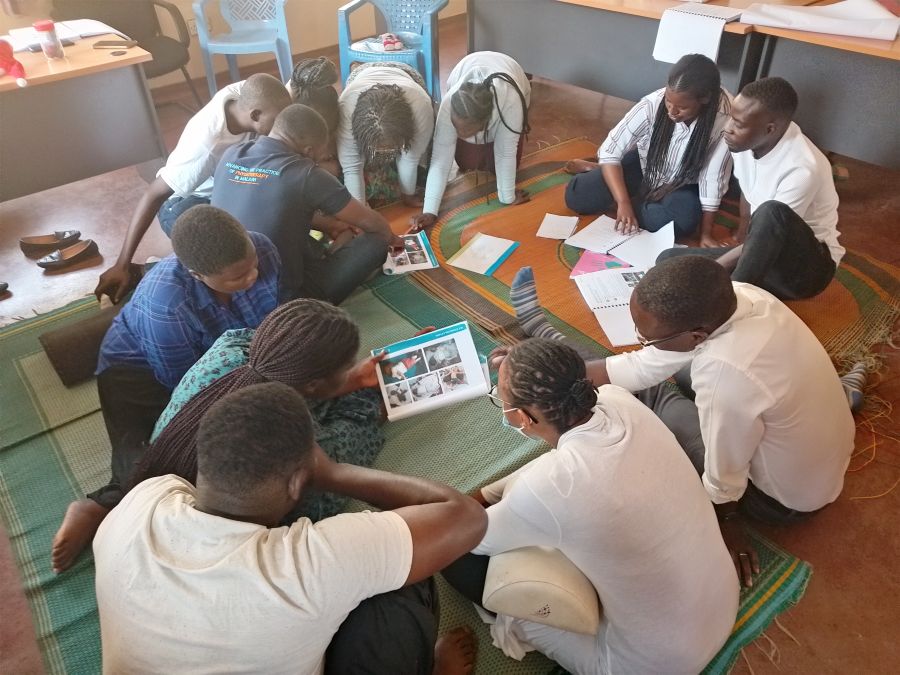
Participants take part in Baby Ubuntu training.
What Malawi changed about the way I see Baby Ubuntu
I travelled to Malawi believing that I was going to present Baby Ubuntu. I did. But I also discovered that presenting a programme is only one part of what it means to represent it. You have to be willing to have your own thinking challenged and learn from other models.
The Malawi experience strengthened my conviction that Baby Ubuntu has an opportunity to grow not simply by becoming bigger, but by becoming deeper, more connected and more adaptable. Our exhibition created conversations around early intervention and caregiver-centred support. The learning visit exposed us to Malawi’s experience. The exhibition showed us African ingenuity. The summit challenged us to think about financing, sustainability, workforce capacity and locally driven solutions. And the relationships created across countries opened doors for continued learning and collaboration. That is what makes this experience meaningful. The value of the trip is not simply that I travelled to Malawi. The value is what can happen because I travelled to Malawi.
The real return on the investment
I am deeply grateful to the partners and donors whose support made this journey possible. For me, that support comes with a responsibility. When someone invests in sending a practitioner to a continental learning platform, the return should not be a travel report, it should be knowledge that comes home, it should be new partnerships, it should be stronger systems.
That is the return this Malawi journey generated. I left Uganda carrying the experience of Baby Ubuntu. I arrived in Malawi ready to share it. I returned home carrying ideas from Malawi, lessons from colleagues across Africa and a renewed determination to keep improving what we do.
The flight home eventually came. The bags were packed and the conference badge was put away. But the work did not end in Lilongwe. In many ways, it was only beginning.