

At the GLOW 2026 Conference, co-hosted by University College London and the London School of Hygiene & Tropical Medicine (LSHTM), the Baby Ubuntu team hosted a parallel session, Parent Power and the Voice of Ubuntu: Re-imagining Inclusive Care for At-Risk Newborns. The session was part of the conference’s Power, Voice and Innovation theme. It asked one central question: what happens when parents are involved as leaders in care, not just recipients of it?
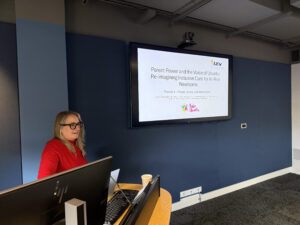
Professor Cally Tann chairing our session
Chaired by Professor Cally Tann, the session brought together researchers, implementers and expert parents from Uganda, Rwanda and the UK. They looked at the evidence for caregiver-led approaches and how power can be shared with families in practice.
Ten years of evidence
Carol Nanyunja and Cally Tann opened with an overview of Baby Ubuntu. They set out what a decade of research has shown about the expert parent role and shared emerging findings from the PDC/Baby Ubuntu trial in Rwanda. With 1,472 children enrolled across 56 health centres, it is the largest trial of an early childhood intervention for children at risk of developmental disability in sub-Saharan Africa. Findings point to greater child participation, improved family quality of life, increased caregiver confidence and reduced disability-related stigma.
Voices from Rwanda
Attendees saw the first screening of a new short film sharing caregivers’ perspectives from Rwanda. Mathieu Nemerimana of Partners In Health, Rwanda, described how Baby Ubuntu was integrated into Rwanda’s Paediatric Development Clinics and scaled through the public health system. Expert parents have shaped every stage of this work, from programme adaptation and choosing outcomes to delivering groups and challenging stigma in their communities.
The power of lived experience
Kirsten Prest was joined by expert parent partners Alea Jannath and Keely Thomas. They reflected on co-adapting Baby Ubuntu for families in the UK through Encompass, a programme for caregivers of young children with complex neurodisability, piloted in East London. Alea and Keely described their path from first-time research partners to co-designers, co-facilitators and co-authors, involved in every stage from design through to publications and conferences. They spoke about how the role has built their confidence to speak up, advocate in their children’s care and support other families. Keely and Alea also shared what they want professionals to know about involving caregivers: mutual respect for different kinds of expertise, listening properly, plain language and flexibility on all sides.
What does parent power mean?
Participants shared their views throughout the session using live polls. Asked what “parent power” means to them, attendees most often described it in terms of voice and partnership: being heard and listened to, equal partnership, advocacy, inclusion, and involvement that is meaningful rather than tokenistic. Many also saw parents as active partners in care and as a source of change.

Participant responses to ‘What does parent power mean to you?’
When asked what meaningful lived experience leadership looks like in their own settings, participants moved from principles to practice. Responses included community priorities driving research questions, outcomes that matter to parents, and parents involved as experts in the design of services and research. Others named concrete signs of shared power: parents as co-applicants on grants, co-authors on publications and members of trial management groups, and being paid for their time. Flexible ways of working, such as arranging meetings around parents’ schedules, were also seen as essential. Taken together, the responses describe lived experience partners holding equal power in decision-making, research design and service improvement.
Across evidence from Uganda, Rwanda and the UK, the session showed that when parents lead in care rather than only receive it, programmes become more relevant, more inclusive and more effective for families. The Baby Ubuntu team thanks everyone who attended and contributed to the discussion, and the GLOW 2026 organisers for hosting the session.
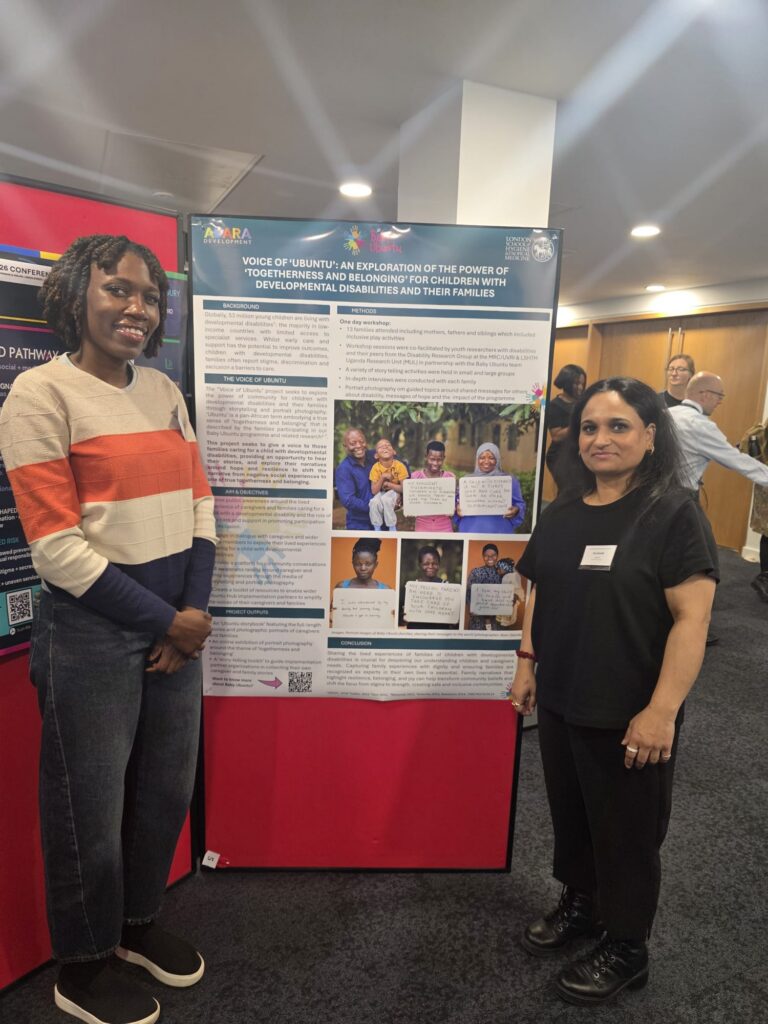
Carol Nanyunja and expert parent Alea Jannath with our ‘Voices of Ubuntu’ poster